

Aviator Demo Limits of Free Practice
Aviator is a crash game from Spribe built around an increasing multiplier that can stop at any time. The demo lets a player study the interface and round flow without registration, but it cannot reproduce the financial pressure of staking money.
This guide explains what free practice can teach, which parts of real betting remain outside the demo, and how operator free bets differ from demo play. It also gives the key probabilities, timing details, and operator-dependent values that matter when moving to real stakes.
What Demo Shows
Aviator demo mode displays the crash-game interface without requiring registration. Spribe designed Aviator for desktop, tablet, and mobile browsers, including low-bandwidth connections and budget devices.
The practice round uses the central mechanism: the multiplier rises from take-off until the round crashes. A player must cash out before the crash to collect the displayed multiplier on the stake used for that bet.
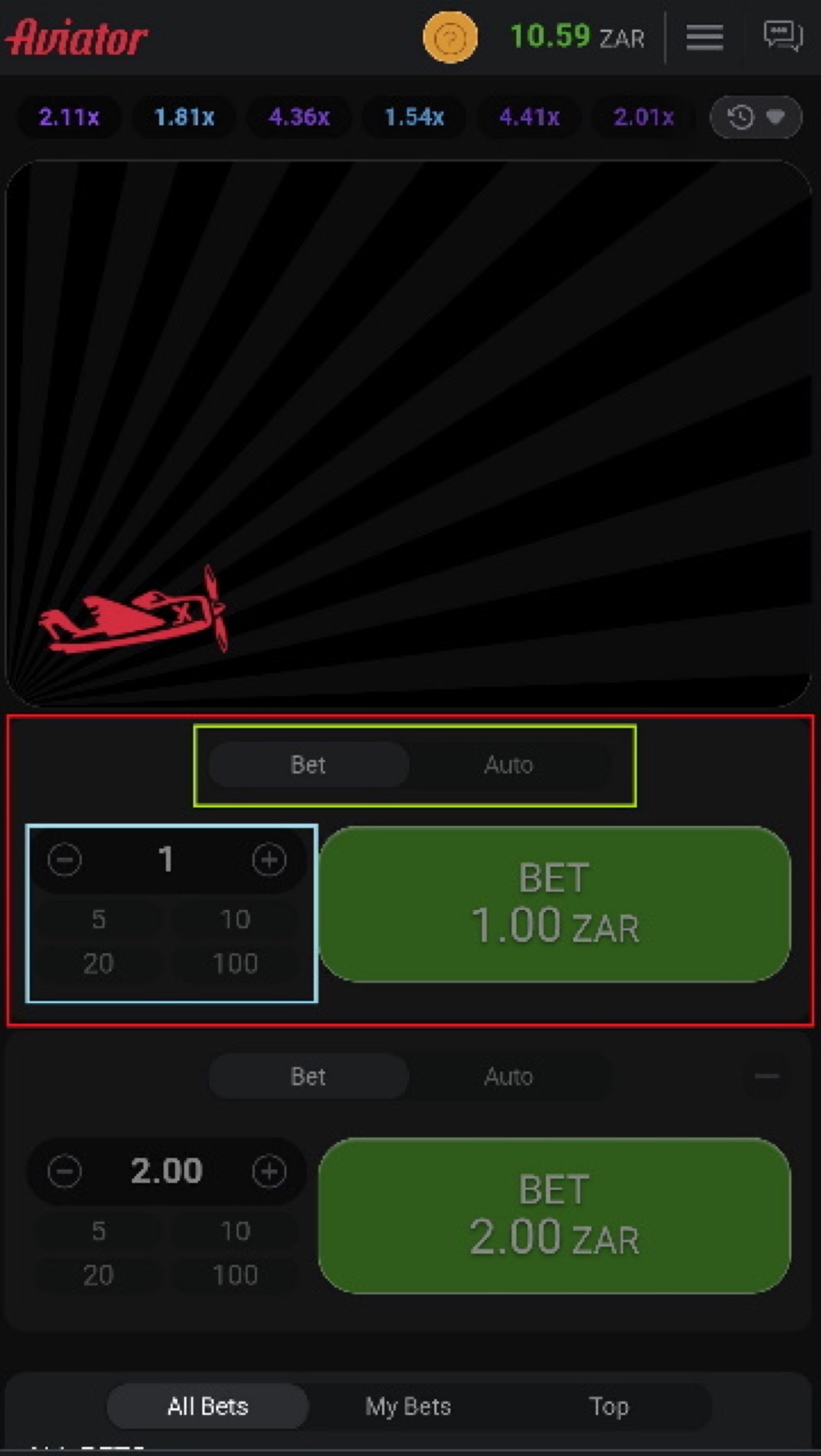
The Aviator mobile view shows the interface used for free practice on a phone.
The demo can help a new player identify the main controls before using a bookmaker account. The interface includes:
- Two bet panels for each round.
- Separate cash-out controls for the two bets.
- Bet and Auto tabs.
- An Auto Cash-Out option at a preset multiplier.
- Auto Bet or Auto Play for 10 to 100 rounds.
- A round-history display showing earlier multipliers.
- A live-bets panel with All Bets, My Bets, and Top views.
- In-game chat and a Provably Fair badge.
Two bet panels allow different cash-out plans in one round. For example, one bet can use an automatic cash-out at a lower multiplier while the second uses a separate target, although the demo does not make either target profitable.
The practice screen also exposes the order of events. The player chooses a stake, waits for take-off, watches the multiplier rise, and attempts to cash out before the crash. The round history then records the previous multipliers for later viewing.
How A Round Works
Aviator rounds usually last about 8 to 30 seconds. The game normally completes 60 to 90 rounds per hour, with only a few seconds between rounds.
The crash point is fixed before take-off through the provably fair system. Before each round, the server publishes a SHA-256 hash of the server seed, and player client seeds are combined with it.
| Target multiplier | Probability the round reaches it | Practical meaning |
|---|---|---|
| 1.2x | 80.8% | The round reaches a low target often, but not every time. |
| 1.5x | 64.7% | A target below two times still loses on many rounds. |
| 2x | 48.5% | The round reaches two times in fewer than half of all rounds. |
| 3x | 32.3% | Three times occurs less often than one time in three. |
| 5x | 19.4% | A five-times target has high variance. |
| 10x | 9.7% | Ten times occurs in fewer than one in ten rounds on average. |
| 100x | 0.97% | A hundred-times target is uncommon. |
The probability formula is 0.97 divided by the target multiplier. About 3% of rounds, or roughly 1 in 33, crash instantly at 1.00x. A demo can show this result, but repeated practice cannot remove it.
Aviator has an RTP of 97% and a house edge of 3%. The expected value is minus 3% of the stake at every cash-out target, so choosing a different target changes variance rather than changing the edge.
After a round, the server inputs are revealed and can be checked with the verification tool inside the game. Neither Spribe nor the operator can change the result after the round starts.
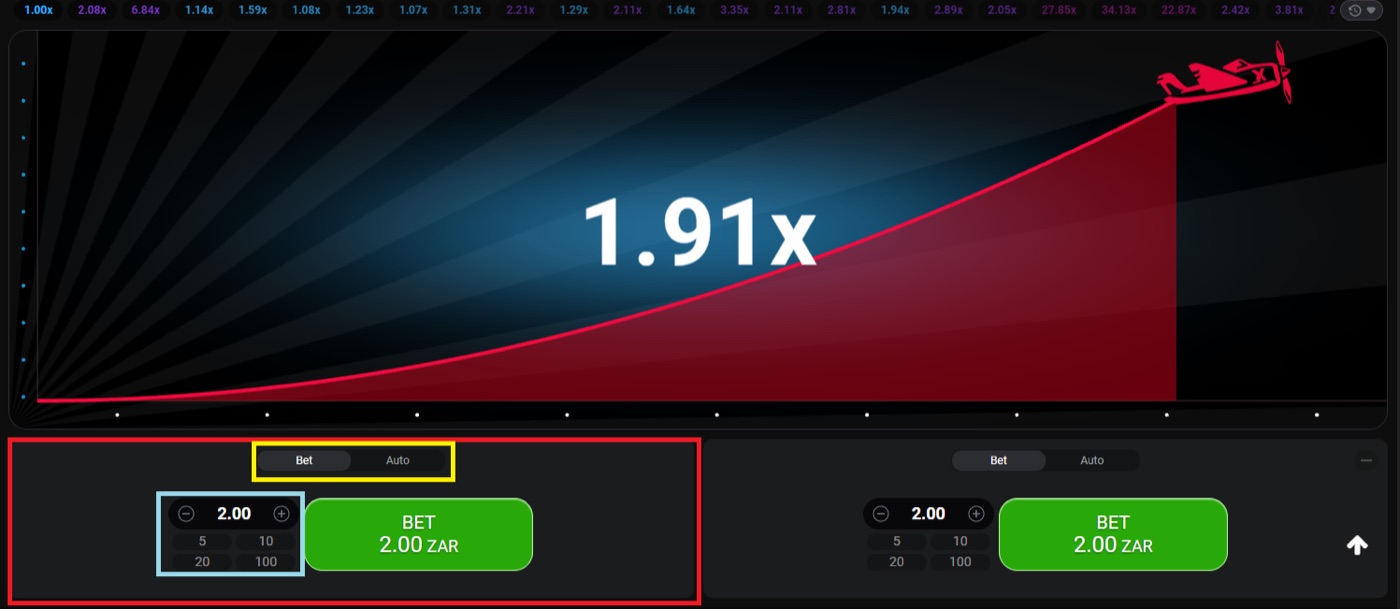
The desktop round view shows a 1.91x multiplier and two separate bet panels.
What Free Practice Hides
Aviator demo mode removes the financial stake from each round. Real betting adds an operator-defined amount, a cash-out request, and a possible loss to the same short sequence of events.
A demo player can test buttons and timing, but the screen does not show how a personal balance changes after a win or loss. That difference matters because the game has high variance even when the selected target is low.
Free practice does not measure these real-stakes effects:
- The effect of losing a chosen amount at an instant 1.00x crash.
- The pressure created by watching a cash-out target approach.
- The result of a cash-out request arriving after the crash.
- The effect of repeated rounds on a limited bankroll.
- The temptation to increase a stake after a loss.
Cash-out requests must reach the server before the crash. A slow device or connection can contribute to a time-out, so a successful-looking click is not the same as a completed cash-out.
The demo also cannot establish a personal winning pattern. Aviator rounds are independent, so previous multipliers do not change the probability of the next result. Patterns, graph analysis, a “best time to play,” and strategy charts do not change the 3% edge.
Automation controls provide a useful interface lesson, not a mathematical advantage. Auto Cash-Out uses a preset multiplier, while Auto Bet or Auto Play can run from 10 to 100 rounds and can include stop-on-win or stop-on-loss settings.
Players should treat predictors and signal tools with caution. The crash point is committed by hash before take-off, so an app or bot cannot predict the result from the visible history.
Moving To Real Stakes
Real Aviator stakes start with the operator rather than Spribe. Typical stakes range from about $0.10 to $100 per bet, but the available amount depends on the operator.
Operator win caps also differ by round and by bet. Spribe does not publish a maximum multiplier, and guides quote different figures, so a player must check the terms shown by the bookmaker.
A player researching a crash game may encounter the aviator game 1xbet apk while comparing a stake, multiplier, or cash-out interface, but an app reference does not change the game’s RTP or the need to check the operator’s conditions.
Moving from demo to real money requires checking the following values before placing a bet:
- The minimum and maximum stake.
- The maximum win per bet.
- The maximum win per round.
- The available cash-out and auto-play controls.
- The operator’s deposit and withdrawal conditions.
- Any separate terms for promotional bets.
Examples show why one operator’s figures cannot be applied to another. Betika Kenya lists a minimum stake of KES 10, while betPawa Nigeria lists a minimum of ₦1 and a maximum win of ₦340,000,000. These are operator examples, not universal Aviator limits.
Other published examples include SportPesa Kenya stakes of Ksh 2 to 50,000 and a maximum of Ksh 4.5M per bet. Hollywoodbets lists a maximum win of R5M per bet and R10M per round. These values describe those operators and do not define every Aviator account.
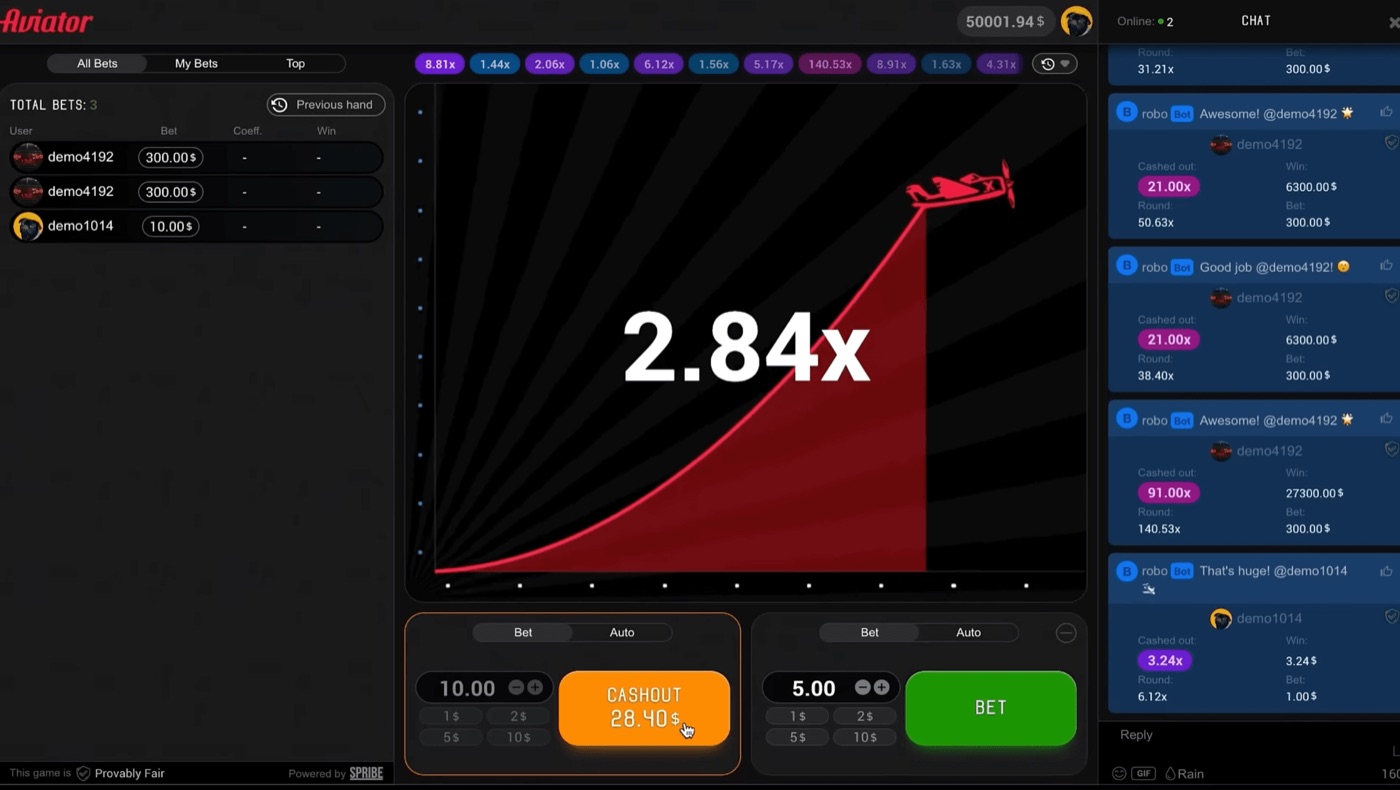
The full interface shows live bets, chat, and a cash-out displayed at 28.40.
Real stakes also expose payment and account procedures that demo mode does not use. Operator examples include M-PESA in Kenya, OPay and PalmPay in Nigeria, and UPI, Paytm, PhonePe, and BHIM in India.
Use a fixed loss limit before real play and stop when it is reached. A stake plan cannot remove the house edge, and the Martingale system reaches 1,024 times the base stake after 10 losses.
Free Bets Are Different
Operator Free Bets are promotional betting credits, while Aviator demo rounds are free practice rounds. Rain Promo free bets are distributed through the in-game chat, and the first players to tap “claim” receive them.
Operators can grant Free Bets individually, in batches, or through an API. The operator sets the applicable conditions, so a free bet is not the same product as unrestricted demo access.
The main differences are:
- Demo mode needs no registration; operator Free Bets normally belong to an operator account.
- Demo play has no real stake; a Free Bet is attached to promotional terms.
- Demo practice is available for learning the controls; a promotion may have a time limit or qualifying condition.
- Rain Promo allocation depends on claiming speed and availability in the chat.
- A tournament or race may rank players on a leaderboard rather than provide ordinary demo play.
Examples from the fact set show how varied these offers can be. SportPesa Kenya lists Aviator Rain of Ksh 1M per day in free bets, while SportyBet Nigeria lists an Aviator Missions weekly pool of 4,000,000 NGN with free bets valid for 3 days.
BetKing Nigeria describes 50 Free Bets after ₦50,000 is staked on Aviator within 7 days. Betway South Africa lists a “10 Free Flights on Aviator” welcome offer. These examples have different triggers and should not be treated as standard Aviator rules.
Chat can carry operator announcements about promotions. A player should read the displayed conditions for the specific account before assuming that a Free Bet can be used, withdrawn, or repeated in the same way as demo play.
Using Demo With Limits
Aviator demo mode gives a player a way to learn the controls before risking a stake. The game’s 8-to-30-second rounds also make it possible to observe how quickly decisions must be made.
Free practice works best when the player uses it to test one setting at a time. It cannot improve the 97% RTP, reduce the 3% house edge, or predict the crash point.
- Run several rounds without changing the default interaction.
- Use each of the two bet panels separately.
- Test a manual cash-out and an Auto Cash-Out setting.
- Watch the round history without treating it as a forecast.
- Check the live-bets panel and chat to understand the interface.
- Stop the session instead of converting repeated losses into larger stakes.
Some guides discuss auto cash-out targets from 1.5x to 2x, split bets, and targets from 5x to 10x. Those approaches change how often wins and losses appear, but they do not change the expected minus 3% of the stake.
A split-bet example makes the limitation clear. A player might place one bet with a lower cash-out target and leave a second bet for a higher target, but both bets remain exposed to the same round crash and the same house edge.
Guides also mention staking no more than 2% of a bankroll per round and setting separate loss and win limits. These are risk-control suggestions, not methods for overcoming the game mathematics.
Responsible gambling means using only money intended for entertainment and stopping at a preset loss limit.
Aviator FAQ
Aviator launched in early 2019 and first went live on Adjarabet in February 2019. Spribe describes it as a social multiplayer game built around an increasing curve that can crash at any time.
The demo and real-money versions share the crash-game concept, but operator stakes, caps, promotions, and account conditions apply only when using a bookmaker.
Can I play Aviator for free?
Yes. Aviator has a demo mode that needs no registration and works in desktop, tablet, and mobile browsers. Demo play lets you inspect the interface without using a real stake.
Does the demo predict real rounds?
No. The crash point is fixed before take-off through the provably fair process, and rounds are independent. Demo results do not predict the next real-money result.
Is Aviator a slot game?
No. Aviator is a crash game and instant game, not a slot. It has no bonus round. The main action is the rising multiplier and the player’s cash-out decision.
Why can a cash-out time out?
The cash-out request must reach the server before the crash. Latency or a slow device can delay the request, so a click made after the crash cannot secure the earlier multiplier.
Is there an official Aviator app from Spribe?
There is no standalone official Aviator app from Spribe. The game runs inside a licensed operator’s website or app, while apps using names such as Aviator or Aviator Predictor are third-party clones.
Do free bets have the same rules as demo play?
No. Operator Free Bets and Rain Promo claims use conditions set by the operator or promotion. Validity, qualification, availability, and any applicable limits depend on the displayed terms.